Top GAMES

A Little to the Left

Become A Fashion Designer

Friday Night Funkin vs Hatsune Miku

The Choicer Voicer
VOTED GAME
The Choicer Voicer 2

Sharks and Minnows

Rooftop Snipers 2

Eye Catching FNF


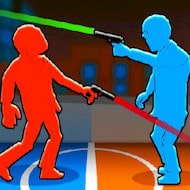






What happens when the ball you just lined up a shot for suddenly turns into a tennis ball and the goal moves half a step to the left? That question is basically the entire pitch for Soccer Random, a two-player soccer game where the sport stays recognizable but almost everything else about the match resets after every single goal. Two stickmen, one shared control scheme, and a field that refuses to look the same twice.
Soccer Random gives each player exactly one key. Player one uses W, player two uses the Up Arrow, and that single input covers jumping, heading, and kicking all at once. There is no separate pass or shoot command, so timing a jump toward the ball is the entire skill set the game asks for.
Because both stickmen jump using the same motion regardless of where the ball is, a lot of goals come from being in the right spot rather than executing a precise move. A jump thrown a half second early sails over the ball completely, while a jump thrown a half second late lets the ball bounce past you into your own goal.
The physics behind that single button are loose on purpose. Your stickman’s legs and torso react to momentum in ways that do not always match what you pressed, which is exactly why lining up the same shot twice in a row rarely produces the same result.
Scoring a goal in Soccer Random does not just add a point, it resets the entire setting. A match can open on a plain Back Yard field, then switch to a sandy Beach court after the first goal, then jump to a Snow Field a minute later, with lighting alternating between day and night along the way.
The ball changes just as often as the background. Some goals are scored with a full-size soccer ball, others with a tennis ball that bounces faster and smaller, or a volleyball that behaves nothing like either. Player costumes shift to match the setting too, so a goal celebration in swimwear on the Beach field can be followed immediately by a goal attempt in winter gear on snow.
None of these changes are cosmetic only. A tennis ball on a Snow Field reacts to a jump kick completely differently than a soccer ball on the Back Yard field, which means the muscle memory you build up in one setting can actively work against you in the next.
New players tend to treat every goal attempt the same way, jumping the instant the ball gets close regardless of what field or ball type just loaded in. That works for maybe the first goal of a match and then starts failing once the physics shift.
The players who improve fastest learn to glance at the ball type and field before committing to a jump, since a smaller ball like a tennis ball needs a tighter, later jump than a full-size soccer ball rolling across the Back Yard field. Reading that half-second window before the ball arrives matters more than reaction speed on its own.
The most common failure point is chasing the ball across the field instead of positioning near the goal and waiting. Soccer Random rewards patience far more than aggressive chasing, since a mistimed jump often sends your own stickman sprawling out of position for the rebound.
A Soccer Random match ends the moment either side scores five goals, and because every goal also resets the field and ball, a match rarely feels like a straight line from start to finish. A team down four goals to two can still win if the next three goals happen to fall their way under a setting that favors their timing.
Long rallies are rare. Most goals come from a single clean bounce off a jump, which means matches often swing on one or two key moments rather than sustained possession.
Plenty of people load Soccer Random for a quick single-player match against the CPU just to see how many random field changes they can adapt to before losing five goals. That solo crowd treats each new Beach or Snow Field reset as its own small test.
The local two-player crowd is the more common way people actually experience Soccer Random, with both players on the same keyboard using W and Up Arrow. Sitting side by side turns a mistimed jump on a tennis ball into a shared joke rather than a frustration, since neither player controlled which ball type just loaded in.
Speedrun-minded players treat five-goal matches almost like a timer, trying to close out a win as quickly as possible regardless of how unfavorable the current field or ball happens to be. All three groups end up using the same list of tricks:
Soccer Random never pretends to be a realistic soccer sim, and that is the entire point once a goal resets the pitch from the Back Yard field straight into a Snow Field with a tennis ball rolling toward your stickman. Winning five goals before your opponent does means reading that reset faster than they do, which is the one skill in Soccer Random that never goes out of style.