Top GAMES

A Little to the Left

Become A Fashion Designer

Friday Night Funkin vs Hatsune Miku

The Choicer Voicer
VOTED GAME
The Choicer Voicer 2

Sharks and Minnows

Rooftop Snipers 2

Eye Catching FNF







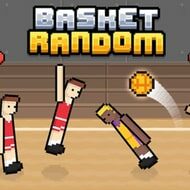
You line up what should be an easy shot from right under the hoop, press your key, and watch your stickman’s arm stretch out like taffy and send the ball sailing over the backboard instead. That single moment sums up Basket Random: a two-player basketball game where the rules of basketball stay the same but the physics never do. One second you are dunking with ease, the next your player’s legs buckle mid-jump because the court just changed underneath you.
Basket Random strips basketball down to a single input. In single-player mode you control your stickman with the W key, jumping toward the hoop and releasing to shoot. In two-player mode, a second stickman is controlled with the Up Arrow key, so two people can share one keyboard without ever touching the mouse. There is no separate shoot button and no way to aim with a cursor, which sounds simple until you realize the game never lets your character move the same way twice.
The stickmen themselves are ragdolls, not animated athletes. Their joints flop, their torsos tip forward when they land badly, and a shot that looked perfectly lined up can still clang off the rim because the player’s arm snapped at an odd angle on release. New players usually blame their timing when a shot misses, but most misses in Basket Random come from the physics of the moment, not a bad button press.
Because both players share the same control scheme, matches turn into a strange kind of teamwork. You are not aiming so much as reacting to how your own character is currently built for that round, then adjusting your jump to compensate.
The defining feature of Basket Random is what happens the instant a ball goes through the hoop. The court resets, and along with it the background, the lighting, and often the players’ outfits change to match a new setting, from a plain indoor gym to a beach court or a snowy outdoor lot. This is not cosmetic filler between points; the new setting frequently comes with a new physics twist attached.
Arm length is the modifier players notice first. One round your stickman has short, stiff arms that barely reach the rim on a jump shot, and the very next basket gives you arms long enough to dunk without leaving the ground. Ball weight changes just as often. A heavier ball arcs differently and needs a harder release, while a lighter one floats and overshoots if you shoot with your normal timing.
Occasionally a round will mark certain baskets as worth double points, which can flip a losing scoreline in one shot if you notice the change before your opponent does. Because these swaps happen without warning text, reading the new round in the first second after the ball resets is one of the few skills that actually carries over from match to match.
Across enough rounds of Basket Random, a handful of recurring changes show up often enough that regular players start expecting them, even if the exact order is never the same twice.
None of these are announced with a pop-up or a label. You learn to spot them by watching your own stickman’s proportions for a half second before committing to a jump.
Basket Random plays in short bursts. Whichever side scores first gets one point, and the team that reaches five points first wins the match outright, which usually takes only a few minutes even with the constant physics resets slowing down clean shots. Because a single made basket can be worth two points during a double-point round, a match that looks locked at three to three can end in one possession.
Beginners tend to lose points not because they cannot score, but because they keep shooting with the same timing regardless of what changed. A player who pauses for a beat after the court resets, notices the new arm length or ball weight, and adjusts the height of the jump accordingly will consistently outscore someone mashing the same rhythm every round.
The failure point most players run into is overcommitting on a jump right as the physics shift, sending their stickman sprawling instead of into a clean layup. Recovering from a bad landing costs precious seconds in a game where possessions flip fast.
Players who load up Basket Random alone are usually testing themselves against the CPU opponent, trying to see how many random modifiers they can adapt to in a row without dropping a match. This solo crowd tends to treat each round as a small puzzle, since the CPU reacts to the same physics chaos the player does.
The two-player crowd is a different audience entirely. Sharing one keyboard with a friend, using W and Up Arrow side by side, turns the same random modifiers into a running joke rather than a challenge, especially when both players’ stickmen get stretched arms in the same round and every shot becomes a flailing mess.
A smaller group of returning players treats Basket Random almost competitively, tracking how quickly they can close out a five-point match and comparing how well they read a new court setting versus how badly they whiffed the last one. All three approaches work because the one-button control scheme never punishes anyone for lacking mechanical skill, only for lacking attention to what just changed.
Basket Random randomizes arm length, ball weight, and court settings every time a basket is scored. There is no pattern to predict which modifier comes next, so the only reliable approach is watching your stickman’s proportions for a moment before you jump.
The match ends immediately once either side hits five points, and a new match can start from scratch with a fresh court and fresh set of random modifiers, so nothing carries over between games.
Yes. Player one uses the W key and player two uses the Up Arrow key, which is the entire control scheme for both single-player matches against the CPU and local two-player matches on one device.
Basket Random keeps its rules simple on paper, but the moment a double-point basket lands during a round where your stickman already has stretched-out arms, it stops feeling like basketball and starts feeling like a physics toy that happens to have a scoreboard. That gap between the sport it copies and the chaos it actually delivers is exactly why Basket Random keeps people coming back for one more five-point match.